Quick answer: A calm down corner is a familiar place where a child can pause with adult support and choose one practiced calming action. Start with an ordinary chair or floor cushion, a simple feelings visual, and two tools already in the home. Introduce the space when everyone is calm; never use it as forced isolation or punishment.
A shelf of sensory toys is not what makes a calm corner useful. The important part is the route into and out of the space: how the adult notices distress, how the child receives help, what choices are available, and how the family reconnects afterward.
That route should be practiced before the next hard moment.
What a calm down corner is—and is not
A home calm corner is an optional regulation space. It can be a cushion beside a book basket, a quiet chair in the living room, or a small spot under a table. It does not need to look like a classroom center.
It is not:
- a place a child is banished for upsetting an adult;
- a promise that every meltdown will stop quickly;
- a collection of toys available only after unsafe behavior;
- a substitute for supervision, connection, or professional support.
The American Academy of Pediatrics’ guidance on healthy emotional development describes acknowledging, naming, and validating emotions while maintaining boundaries around behavior. The corner gives that sequence a consistent physical home.
Set up the space with what you already own
Choose a visible, low-traffic spot
The child should not feel hidden or trapped. Choose a place an adult can supervise without standing over it. Avoid spaces beside breakable objects, stairs, cords, or a busy television.
Provide a comfortable base
Use a floor cushion, small rug, beanbag, or regular chair. Comfort matters; themed furniture does not.
Add one feelings cue
A page with four familiar faces—sad, angry, worried, and calm—may be enough. For a child who does not want to name a feeling, point to body clues instead: tight hands, fast breathing, hot face, or a stomach that feels jumpy.
Offer two or three tested actions
Choose items the child has used safely: a board book, a pillow to squeeze, paper and crayons, headphones without a device, or a card showing slow breathing. Too many choices make the space harder to scan.
Show how the pause ends
The child might return when their body feels ready, ask for help, or choose a short reconnection action. Do not make perfect calm or an apology the price of leaving.
Teach the corner during a neutral moment
Spend five minutes introducing the space when nobody is in trouble.
- Name its purpose: “This is a place we can use when feelings are getting too big for what we are doing.”
- Model one body clue: “My shoulders feel tight, so I am going to sit and breathe out slowly.”
- Try both choices: let the child squeeze the pillow and look at the book.
- Practice returning: stand up, put the item back, and rejoin a simple activity.
Repeat the practice briefly on another calm day. A poster seen for the first time during intense distress is decoration, not yet a learned support.
A four-part parent response
1. Notice without arguing
Describe what is visible: “Your hands are tight and your voice is loud.” Avoid asking a child in distress to explain the entire event.
2. Hold the safety boundary
Feelings are allowed; hitting, biting, throwing at people, or running into danger still requires an adult response. Move objects, block unsafe actions as appropriate, and stay close. The corner is not an alternative to keeping people safe.
3. Offer one supported choice
Say, “Sit with me on the cushion or squeeze the pillow beside me.” If choosing is too much, reduce the language and offer presence rather than another question.
4. Reconnect after the body settles
Keep the review short. Name what happened, repair any harm, and decide whether one practical change is needed. A preschooler does not need a long lecture to prove the corner worked.
The AAP’s Creating Calm guidance emphasizes calm adult presence, listening, and connection when a child’s stress response is active.
Three real-life ways to use the space
Frustration during building play
A block tower falls and the child starts throwing pieces. The adult moves the bin, says, “Blocks stay low. Your hands need a pause,” and offers the cushion or a firm pillow squeeze. The blocks return only when throwing has stopped. The calm corner supports the pause; it does not erase the limit.
A sibling conflict
The adult separates the children and checks safety first. Each child gets space without being required to agree on a shared story. Later, the adult helps with a concrete repair—returning an item, checking an injury, or practicing the words needed next time.
Overload after school
The child uses the chair, water, and headphones for a planned ten-minute arrival pause before conversation. In this case the space is preventive, not a response to misbehavior. A complete after-school routine can make that recovery period predictable.
Match the tool to the child
A child who wants movement may dislike being asked to sit. Offer wall pushes, carrying a laundry basket with an adult, or a short supervised walk instead. A child who seeks quiet may need fewer words and lower light. Another may regulate through connection and want an adult nearby.
Observe what helps the child become available for the next safe action. Do not force breathing exercises, eye contact, or emotion labels. The preschool calm-down plan provides a broader sequence for noticing triggers and teaching replacement actions.
Common setup mistakes
Calling it a calm corner but using it like timeout. If the child is sent away whenever the adult is angry, the space will signal rejection. Offer it as support and stay available.
Adding a dozen sensory objects. Keep only items the child already uses safely. Rotate a stale tool instead of filling another basket.
Expecting independent regulation too early. Young children often need co-regulation: an adult’s steady voice, proximity, and help choosing the next action.
Talking through the whole conflict immediately. Address danger first and save problem-solving for when both people can participate.
Using the corner only after escalation. Invite brief preventive pauses after school, before a demanding transition, or when early body clues appear.
When a corner is not enough
Frequent intense distress can have many causes, and a printable cannot identify them. Seek individualized guidance when a child is repeatedly unsafe, harms themselves or others, cannot recover with usual support, loses skills, or has distress that disrupts sleep, school, eating, or family life. Start with the child’s pediatrician or another qualified professional; urgent safety concerns require immediate local help.
For a child whose distress centers on ending a device, use the screen-time transition plan. For repeated hitting or biting, the family safety rules guide keeps the behavior boundary separate from the calming choice.
A simple printable option
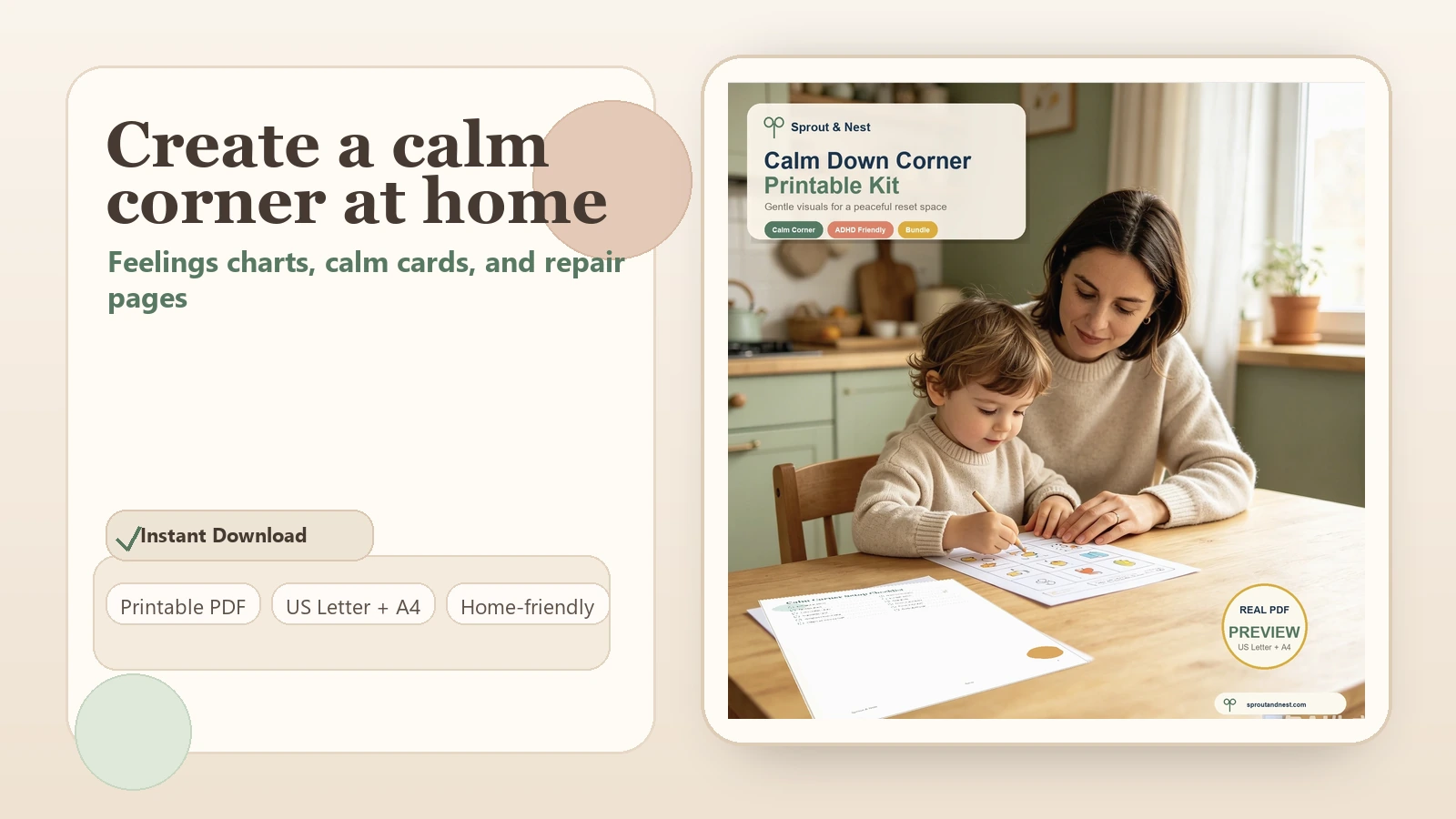
Begin with a handwritten feelings page and two choice cards. If the child responds to that format, the Calm Down Corner Printable Kit can make the system reusable. The Big Feelings Wheel is an optional naming tool for a child who finds it helpful; it should not become a quiz during distress.
Frequently asked questions
Is a calm down corner the same as timeout?
No. A calm corner offers regulation support and connection. If it is imposed as isolation or shame, the child experiences it as punishment regardless of the label.
Should a child have to stay for a set time?
A timer may help some children understand a short pause, but calm is not produced on schedule. Keep safety boundaries in place while allowing the child to signal readiness or ask for help.
What if the child refuses to use it?
Do not drag the child into the space. Bring one familiar tool closer, regulate alongside them, and practice the corner later when everyone is settled.
Can siblings share one calm corner?
They can share the location if each child has safe choices and an adult can manage conflict over the space. During a sibling fight, separate areas may be more practical.