Quick answer: Montessori at home does not require a special playroom or a shelf of matching materials. Start with one real household task the child can practice safely, arrange the needed items within reach, demonstrate the action slowly, and include cleanup. Keep the activity only while it matches the child’s current interest and ability.
A three-year-old who wants to pour water beside you may not need a themed transfer tray. They may need a small pitcher, two cups, a cloth for spills, and time to repeat the action without the adult taking over.
The useful part of a Montessori-inspired home is not the photograph. It is an environment that lets a child participate in real life with increasing independence.
Begin with a household friction point
Choose one moment where the child wants to help but the environment says no: reaching the sink, putting shoes away, serving a snack, wiping the table, or choosing clothing. Ask:
- Can the child reach the materials safely?
- Is the task one clear sequence?
- Can the amount be made child-sized?
- Is cleanup part of the setup?
- Can an adult supervise without completing every step?
Change the environment before buying a new activity. A low hook, a small basket, or fewer items in a drawer may solve more than another printable.
Use a four-part activity test
Purpose
The action should have a visible reason: water goes into the cup, socks become pairs, crumbs leave the table, or a plant receives water. A task with a real finish is easier to understand than a tray of objects arranged only for adult approval.
Reach
Store a limited amount where the child can access it safely. Adult-only tools, medicines, chemicals, sharp objects, and choking hazards remain secured regardless of the child’s interest.
Sequence
Show the steps slowly with little language. For table wiping: take the cloth, wipe from one side to the other, return the cloth, and check the floor. Let the child repeat instead of interrupting every imperfect movement.
Reset
Define where used items go. If the child cannot complete the reset independently yet, share the task without turning cleanup into a surprise consequence.
Ten practical-life activities using ordinary materials
- Pair clean socks and place them in a drawer.
- Pour a small amount of water between two stable cups.
- Wash a child-safe toy with a cloth and bowl.
- Carry napkins to the table one at a time.
- Use a small brush and pan for dry crumbs.
- Transfer laundry from a basket to the machine with an adult.
- Mist or water one plant with a measured amount.
- Peel a banana and place the peel in the bin.
- Hang a coat on a reachable hook.
- Match lids to containers that are safe and easy to handle.
Choose one or two, not all ten. Repeat the same task across a week so the child can notice the sequence rather than constantly learning a new setup.
Six quiet table activities
When an adult needs a contained option, use materials already appropriate for the child:
- match identical household objects or picture pairs;
- sort large items by one visible feature;
- thread large pieces designed for the child’s age;
- open and close familiar containers;
- arrange picture cards in a simple sequence;
- draw one object placed on the table.
Small parts require judgment about age, mouthing, and supervision. “Montessori-inspired” is not a safety certification.
How to present an activity without turning it into a lesson
- Invite rather than quiz: “Would you like to see how I water this plant?”
- Carry the materials to the work area.
- Demonstrate at the child’s pace with minimal explanation.
- Offer a turn and step back far enough for genuine effort.
- Help only at the point that blocks continuation or affects safety.
- Return the materials together when the activity ends.
The American Montessori Internationale’s research summary describes features associated with Montessori environments, including organized materials, choice within limits, and uninterrupted work. A busy home can borrow those principles without claiming to reproduce a Montessori classroom.
Build one reachable area
Choose a single location: the entryway, a kitchen drawer, the bathroom sink area, or one shelf. Remove excess choices and place the most useful items where they have a clear home.
Example entry setup:
- one low hook for the current coat;
- one basket for daily shoes;
- a small seat for putting them on;
- a picture showing coat, shoes, and bag;
- adult storage for seasonal or unsafe items.
If the main issue is remembering the sequence rather than reaching it, connect the area to the morning routine guide.
Rotate by observation, not by calendar
Keep an activity while the child returns to it and is refining the action. Change it when it is consistently ignored, too easy, unsafe, or creates more adult work than participation. Rotation may happen after several days or several weeks.
Before replacing the whole activity, change one variable: the amount of water, the number of pairs, the location, or the level of adult help. Constant novelty can hide whether the child is developing independence.
What often goes wrong
The shelf is beautiful but unavailable. Materials displayed above the child’s reach still require adult permission and retrieval.
The setup takes longer than the work. Replace it with a real household action already happening that day.
The adult corrects every detail. Protect safety and the purpose of the task, then allow a different grip, pace, or imperfect result.
Too many choices appear at once. Offer a few known options and store the rest.
Independence becomes adult withdrawal. Young children still need connection, supervision, and help. Independence means meaningful participation, not managing alone.
Montessori-inspired play and open play can coexist
Real-life tasks, pretend play, outdoor movement, books, art, and child-led play can all belong in the same home. The AAP’s discussion of the power of play emphasizes play’s role in development and relationships. Do not replace every spontaneous game with an adult-prepared tray.
For simpler play invitations, see the low-prep sensory play guide. For rotating existing toys, use the toy rotation guide without attaching rotation to a rigid weekly deadline.
Optional printable activity pack
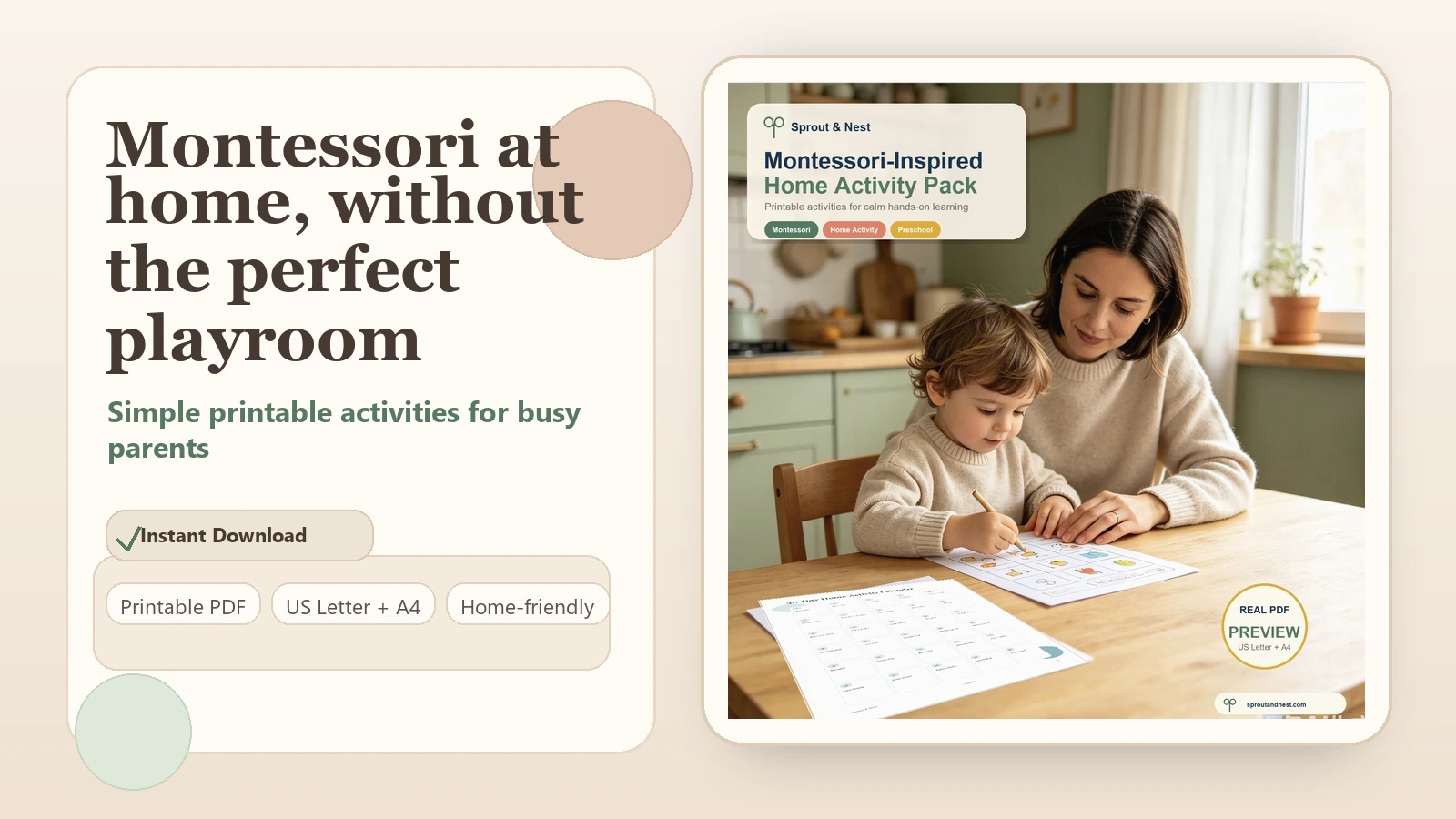
Write down three household tasks the child already watches. If a visual list helps you remember which one to offer, the Montessori-Inspired Home Activity Pack can provide prompts. Use the cards to support observation, not to schedule a new activity every day.
Frequently asked questions
Do I need wooden Montessori materials?
No. Many home independence tasks use ordinary, safe household objects. Specialized materials may have a place in Montessori education, but buying them is not required to make daily routines more accessible.
How many activities should be available?
Offer only the number the child can see, choose from, and help reset. Start with a few familiar options and add one after observing real use.
What if my child uses the material differently?
Step in for safety or damage. Otherwise, observe whether the child’s use has a meaningful purpose. Not every variation needs correction.
Can working parents use this approach?
Yes. Focus on one task already embedded in mornings, meals, laundry, or bedtime. A repeatable two-minute participation opportunity is more sustainable than daily activity preparation.