
Quick answer: A mental load checklist should capture more than visible chores. For each recurring responsibility, record who notices it, decides what is needed, completes it, and follows up. Transfer the whole cycle to one owner wherever possible. Review the system weekly; do not make the overloaded person responsible for maintaining everyone else’s list.
Booking the dentist takes five minutes. Remembering when it is due, finding a provider, checking insurance, choosing a time, arranging transport, completing forms, and scheduling the next visit is the work around the appointment. A normal to-do list often records only “dentist.”
Track the four stages of ownership
- Notice: recognize that something needs attention.
- Decide: choose what, when, and how it will happen.
- Do: complete the visible task.
- Close: confirm, restock, file, or schedule the next cycle.
If one person still notices, assigns, reminds, and checks, the mental load has not transferred even when someone else performs the visible step.
Create an inventory without listing the entire household
Choose one week and five domains:
- school and childcare;
- food and household supplies;
- health and appointments;
- routines, clothing, and activities;
- social, holiday, and family communication.
Write recurring responsibilities, not every tiny action. “School communication” may cover reading messages, identifying deadlines, updating the calendar, and replying.
Assign outcomes, not helper tasks
Compare:
- Helper task: “Please buy toothpaste.”
- Owned outcome: “You own bathroom consumables: notice, choose, buy, and restock.”
Ownership needs authority to make ordinary decisions within agreed limits. If every choice must be approved by the previous owner, the planning work remains in the same place.
Use a weekly handoff table
| Responsibility | Owner | Next visible action | Definition of done |
|---|---|---|---|
| School forms | Alex | Review inbox Tuesday | Signed, returned, calendar updated |
| Weeknight food | Jordan | Choose four dinners | Food available and cleanup assigned |
| Pet medication | Rae | Check supply Friday | Given as directed and refill requested |
Keep private health or financial details in secure storage; the shared tracker needs only the action and owner.
Run a fifteen-minute family reset
- Review the next seven days.
- Name schedule conflicts and care gaps.
- Assign complete ownership for exceptions.
- Move papers and departure items to their locations.
- Stop when the week is actionable.
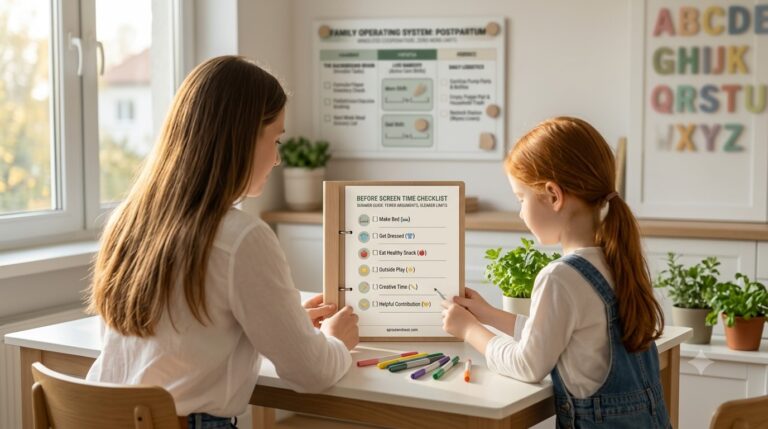
The family command center can display the week, while the tracker records ownership. Do not duplicate every field on both pages.
A worked transfer: school lunch
Before transfer, one parent notices shortages, plans food, checks school rules, shops, packs, washes containers, and reminds the child. “Can you pack lunch tonight?” transfers one action.
A complete handoff assigns the outcome for defined days, agrees on budget and nutrition constraints, shares access to school information, and lets the new owner choose the workflow. The previous owner does not monitor the refrigerator unless a safety or agreed boundary requires it.
Make uneven capacity visible
Equal task counts are not always equitable. Work schedules, disability, illness, pregnancy, postpartum recovery, single parenting, caregiving, and financial constraints change capacity. Mark responsibilities as:
- must happen this week;
- can be reduced or delayed;
- can be outsourced or shared;
- should stop entirely.
The tracker should reduce work, not prove that every category deserves preservation.
Keep children out of adult ownership conflicts
Children can contribute age-appropriate actions, but they should not become messengers between adults or be asked to monitor whether a parent followed through. Put child-facing routines on a smaller chart and keep adult negotiations on the ownership page.
Likewise, do not display arguments, diagnoses, financial strain, or private relationship notes on a family wall. The tracker needs enough information to coordinate the outcome, while sensitive context stays in an appropriate private conversation or secure record.
Use evidence without turning the page into a diagnosis
Research describes cognitive household labor as anticipating needs, identifying options, deciding, and monitoring results. Studies have also examined associations between unequal cognitive labor and maternal well-being. See the peer-reviewed study of cognitive household labor and maternal mental health and foundational work on the cognitive dimension of household labor.
A printable cannot diagnose burnout, depression, anxiety, or relationship problems. Seek qualified health or relationship support when distress is persistent, severe, or unsafe.
What prevents ownership from moving
One person built the tracker alone. Other owners should enter and update their own responsibilities.
Standards remain unspoken. Agree on the outcome, deadline, budget, and safety requirements.
Every mistake triggers takeover. Review the system, not the person, unless immediate safety requires intervention.
The list records only women’s work. Include income administration, maintenance, technology, transport, kinship, and caregiving without assuming who owns them.
The weekly meeting becomes another job for Mom. Rotate facilitation or let the command center define the agenda.
Optional printable tracker
Test ten recurring responsibilities on paper. If the four-stage view exposes gaps, the Mental Load Weekly Tracker can provide a reusable format. Pair it with the postpartum support system when a temporary recovery period changes capacity.
Frequently asked questions
Is mental load the same as chores?
No. Chores are visible actions. Mental load includes noticing, planning, deciding, remembering, and following up around those actions.
How do I get a partner to use the tracker?
Agree on a small set of outcomes they own completely, including updates. A tracker cannot create cooperation when someone refuses responsibility; outside support may be useful.
Should this be daily or weekly?
Use a weekly ownership review and update true changes as they arrive. Daily rewriting can become another form of unpaid administration.
What if I am the only adult?
Use the inventory to reduce, delay, automate, exchange, or request help. The purpose is to expose capacity limits, not assign work to a nonexistent second adult.