
Last updated: June 8, 2026. Summer sounds relaxing until the days stretch open with no structure. By 10 a.m., kids are bored, screens are already involved, and parents feel like they are either entertaining everyone or saying no all day.
A daily summer rhythm gives kids enough predictability to feel settled without turning vacation into school.
Quick answer
A screen-free summer routine works best as a rhythm, not a strict schedule. Divide the day into repeatable blocks: morning reset, outside time, snack, quiet time, creative play, helpful task, and family wind-down. Children follow it more easily when the rhythm is visible and choices are prepared in advance.
Why this problem keeps happening
When summer has no visible plan, screens become the default plan. That can create more arguments because every limit feels sudden.
Most families do not need a more complicated plan. They need a plan that is visible at the exact moment the struggle begins. That is why printable routine charts, cards, logs, and simple checklists can work better than a long explanation.
What parents often try first
- Trying to schedule every hour of summer break.
- Saving all activities for the moment kids are already bored.
- Making screen rules different every day.
- Expecting kids to invent independent play without a menu of choices.
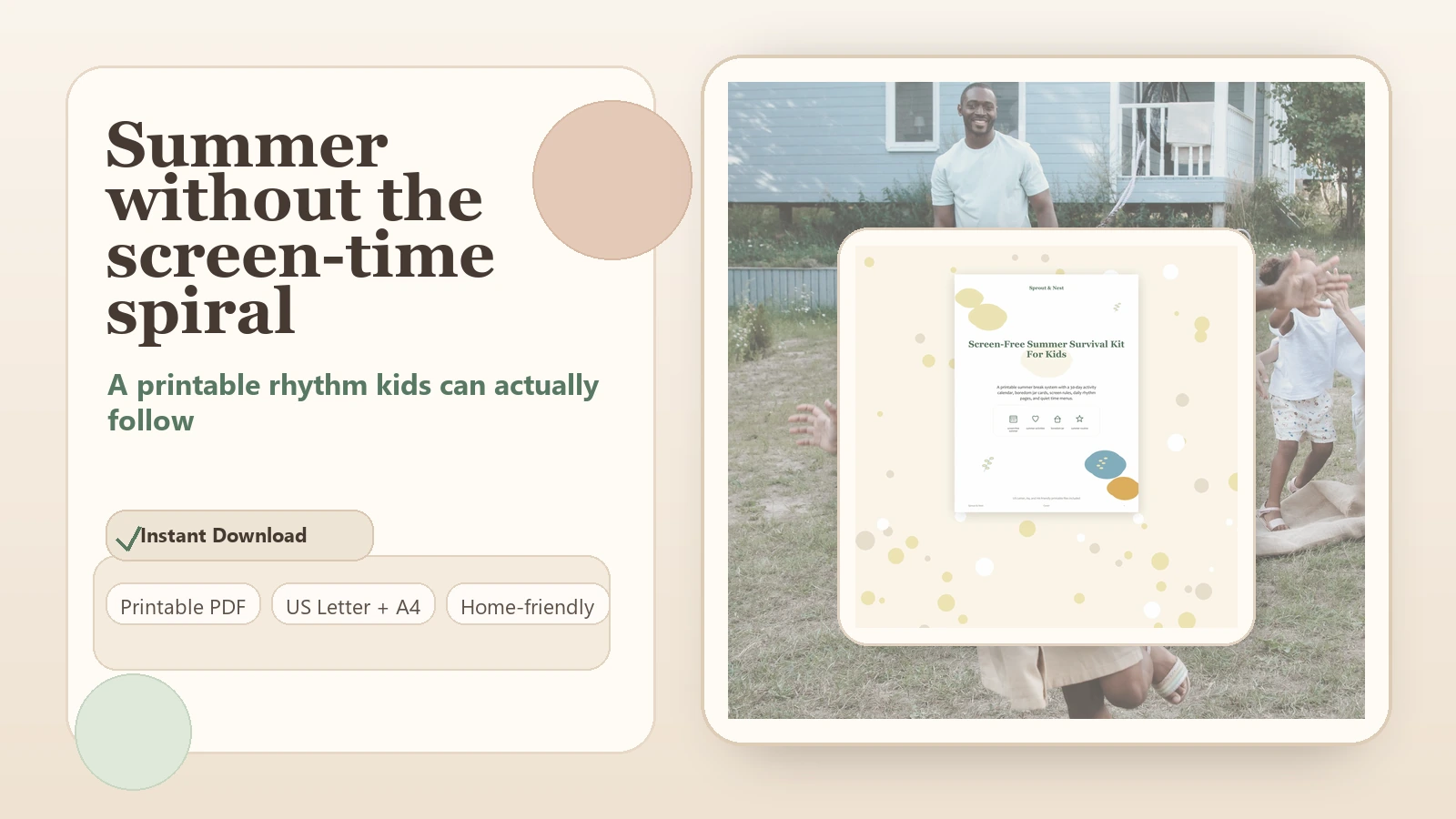
Printable solution: Screen-Free Summer Survival Kit for Kids
If this is the exact problem happening in your home, the fastest next step is not another long parenting article. It is a visible system your child can use today.
Download Screen-Free Summer Survival Kit for Kids
Helpful add-ons: ADHD Summer Break Expansion Pack.
The simple system that works better
Use this as a starting point, then remove anything your family will not realistically use. A system that gets used imperfectly is better than a perfect printable that stays in a folder.
- Create a morning rhythm that does not start with devices.
- Prepare a small activity menu for indoor, outdoor, quiet, and messy play.
- Use a boredom jar so kids can choose instead of asking you to solve boredom.
- Set one predictable screen window if your family uses screens.
- End each day with a reset task so the house does not collapse by Friday.
A simple printable example
Here is a simple structure you can copy or adapt:
- Morning reset
- Outside play
- Snack
- Creative activity
- Quiet time
- Helpful task
- Family wind-down
Who this is best for
This approach is best for families who want clearer screen boundaries, easier transitions, and practical printable tools that help children see what comes before, during, and after device time.
Recommended printable tools
For this topic, start with Screen-Free Summer Survival Kit for Kids, ADHD Summer Break Expansion Pack. These are instant digital downloads designed for home use, with printable pages that can be used as a routine station, planner, chart, or support binder.
FAQ
How do I reduce screen time during summer break?
Do not only remove screens. Replace them with a visible rhythm, a short activity menu, and a predictable screen rule your child can see.
Should summer routines be strict?
No. A rhythm is usually better than an exact schedule. Kids need anchors, not every minute planned.
What can kids do when they say they are bored?
Offer a prepared menu: water play, sensory bin, blocks, drawing, scavenger hunt, quiet book, or helping task.
Helpful Sources
Printable solution: Screen-Free Summer Survival Kit for Kids
If this is the exact problem happening in your home, the fastest next step is not another long parenting article. It is a visible system your child can use today.
Download Screen-Free Summer Survival Kit for Kids
Helpful add-ons: ADHD Summer Break Expansion Pack.
Use a screen-free activity menu before the argument starts
A screen-free summer routine works better when children can see what they can do instead. Create a small activity menu with quiet play, outside play, helper tasks, reading, water play, and reset choices.
Make the menu smaller than you think
Too many options can overwhelm kids and parents. Start with six choices and rotate them weekly. The goal is not entertainment all day; it is a predictable rhythm that reduces negotiations.
Want the screen-free plan already built?
The Screen-Free Summer Survival Kit gives you printable routines, activity menus, checklists, and calm structure for long summer days.
Screen-free summer FAQ
How do I reduce screen time without constant fights?
Set the rhythm before the request. Kids handle limits better when they can see what happens first, what choices they have, and when screen time may happen.
What should I put on a screen-free activity menu?
Use simple categories: build, draw, read, help, move, quiet reset, outside, water play, and sensory play.
Should every summer day have the same schedule?
No. A flexible rhythm usually works better than a strict schedule. Keep anchors like breakfast, outside time, quiet time, and bedtime predictable.




2 Comments