Last updated: June 2026
Summer starts with so much promise, and then the days begin to blur. Breakfast turns into begging for screens, toys spread across the house, and every transition feels like a negotiation.
If you are searching for a summer daily checklist for kids, you probably do not need a perfect summer schedule. You need a repeatable system that your child can understand and that you can actually keep using on tired days.
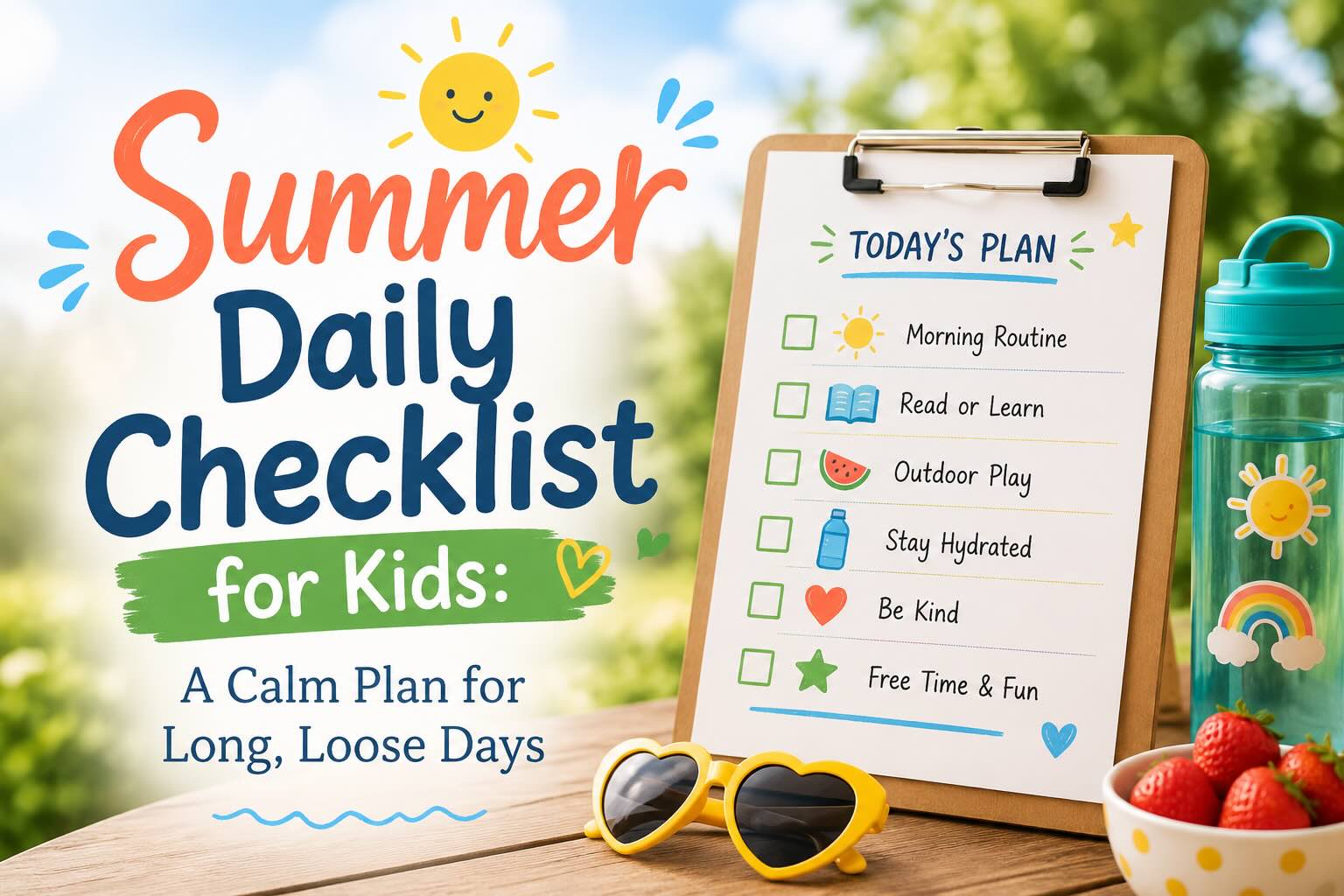
Quick answer: A summer daily checklist works best when it is short, visual, and predictable: wake-up basics, one helpful task, outside movement, reading or learning, quiet time, and a clear screen-time boundary.
Why this summer problem feels so hard
Long, open days ask children to make dozens of small decisions before they are ready to manage them. A short daily checklist removes repeat questions while still leaving room for play, outings, and slow mornings.
The simplest way to build a simple daily summer rhythm
Treat the checklist as a sequence, not a timetable. Put essential tasks first, then show where free choice and screens fit so the boundary is visible before anyone starts negotiating.
- Choose five non-negotiable anchors instead of filling every hour.
- Put the checklist where kids start the day, such as the kitchen or command center.
- Use pictures or very short words for younger children.
- Pair screen time with a before-screen checklist instead of daily arguments.
- Review the rhythm each Sunday and remove anything that creates friction.
What a useful daily checklist should show
Build the list around the order your family already uses. Morning care, movement, one contribution, reading, and a rest point are easier to follow than a clock-based schedule.
- Morning body-care steps
- One household contribution
- Movement or outdoor time
- Reading or creative time
- The condition for screen access
- An evening reset cue
Try it in one real situation
Watch one ordinary summer morning and note the first point where you begin repeating yourself. Build the first version around that friction point, then let your child check or move each item. If the list stalls at the same task for three days, shorten or rename that task instead of adding a reward system.
Common mistakes to avoid
A checklist stops helping when it becomes a full-day performance score. Keep the must-do portion small enough that a child can see the finish line.
- Making the list too long for a child to finish independently.
- Treating summer like school with every minute scheduled.
- Adding screen rules after the meltdown has already started.
Printable next step
Choose the printable that matches the part of the day you want to make visible first:
You can also browse the related toolkit categories:
Frequently asked questions
How many tasks should be on a summer checklist for kids?
For preschool and early elementary kids, five to seven tasks is usually enough. More than that can turn the checklist into another thing a parent has to manage.
Should a summer checklist include screen time?
Yes, but screen time works better as a clear after condition: after breakfast, outside time, reading, and one helpful task.
References
Featured image source: open-license image previously uploaded from Wikimedia Commons.